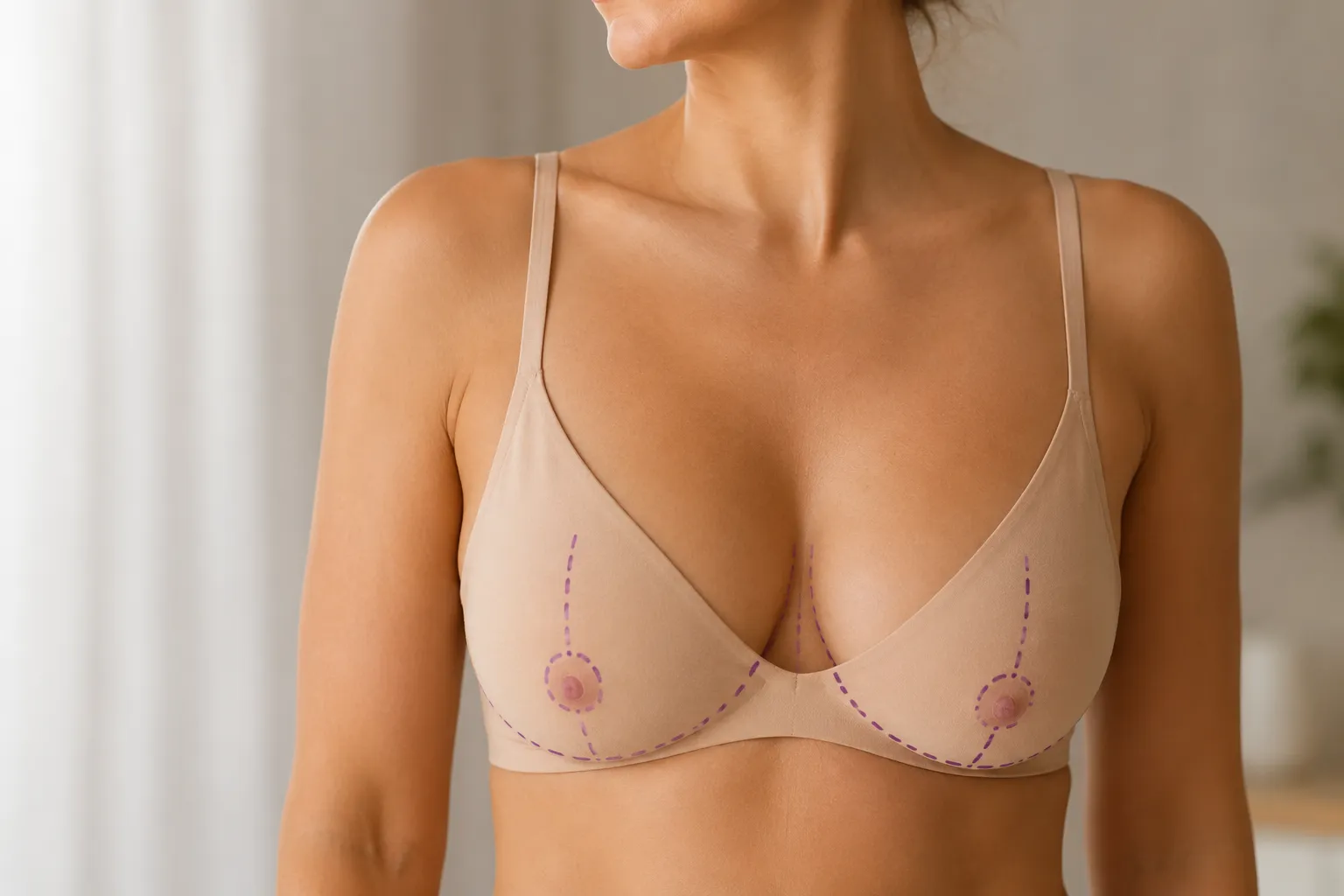
Mastopexy
A breast lift removes selected excess skin and reshapes existing breast tissue to raise the nipple and improve contour. It does not add implant volume, and the amount of upper-pole fullness achievable depends on the patient’s own tissue and skin quality.
The scar may be around the areola, extend vertically to the fold and, when more skin must be removed, continue along the fold. The shortest safe scar pattern is selected according to anatomy rather than preference alone.
Suitable candidates are generally healthy, at a stable weight and concerned primarily with breast position rather than a major increase in volume. A lift can make the breast appear more compact and better positioned, but it does not behave like an implant or guarantee lasting upper-pole fullness. Photographs and video support a preliminary virtual consultation; final scar pattern, tissue safety and achievable shape require in-person examination. Future pregnancy, weight change and ageing can cause renewed descent.
Swelling, bruising, tightness and temporary changes in nipple or breast sensation are common during early recovery. Activity and supportive-garment guidance are individualized, and final shape settles gradually over the following months. International patients should arrive before surgery for examination and testing and generally remain in Yerevan for approximately 7–10 days. Possible complications include bleeding, infection, delayed healing, visible or widened scars, asymmetry, recurrent descent, contour irregularity and partial or complete compromise of nipple-areola blood supply. Smoking increases healing risk.
Send front and oblique photographs together with age, height, weight, pregnancy and breastfeeding history, smoking status and previous breast operations. Relevant breast-lift cases can also be reviewed in the Before & After gallery.
Medically reviewed by Dr. Telman Arakelyan, plastic and maxillofacial surgeon. Last reviewed: July 2026. Final scar pattern, tissue safety and achievable shape require examination.